
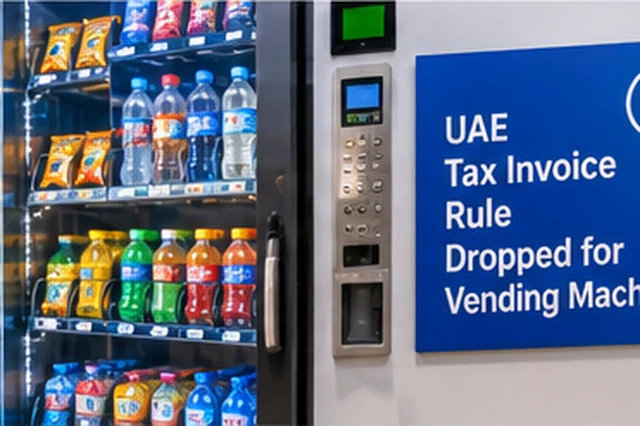
Businesses in the UAE that sell goods or services through vending machines no longer have to issue an individual tax invoice for each sale, under a new directive from the Federal Tax Authority (FTA). The change comes with conditions: sellers must keep sufficient records to back up every transaction, and VAT still applies to the sales.
Directive on Tax Transactions No. 8 of 2026 was issued on November 19, according to Gulf News. It sets out when the exemption applies, defines what counts as a vending machine for VAT purposes, and explains how to treat payments collected by third-party machine operators.
What has changed
Under the directive, taxable businesses supplying goods or services through vending machines are exempt from the requirement to issue individual tax invoices for those sales, provided they maintain adequate records. The directive does not exempt vending machine sales from VAT itself, so the tax must still be accounted for in the normal way.
The three records businesses must keep
To qualify, a business must keep records that show, at a minimum:
- a description of the goods or services supplied
- the total amount received and the tax charged
- the date of supply, determined under Article 26(2) of the UAE VAT Law
Businesses must also retain enough supporting documentation to substantiate those records, Gulf News reported.
What counts as a vending machine
The FTA defines a vending machine as an automated self-service device that supplies goods or services automatically and immediately after a customer interacts with it directly, without the supplier stepping in to complete the transaction.
Routine work such as operating, maintaining, monitoring or restocking the machines is not treated as human intervention under the directive. That means typical snack, drink or ticket machines that are serviced by staff can still fall within the definition.
Rules when someone else runs the machine
Many vending machines are placed and run by an operator on behalf of the business that is actually making the taxable supply. For these arrangements, the directive sets a clear point at which payment is treated as collected for VAT purposes. It is the earlier of:
- the date the taxable supplier receives information from the operator confirming that payment has been collected and stating the amount, or
- the day immediately after 30 days have passed from the date the operator collected the payment.
In practice, this means suppliers cannot defer accounting for VAT indefinitely while waiting for an operator’s report.
Who issued it and what to check
The directive was issued by Mohamed bin Hadi Al Hussaini, Minister of State for Financial Affairs and Vice Chairman of the FTA, and is due to be published in the Official Gazette, according to Gulf News. A public tax law library that tracks FTA releases lists the directive with an issue date of November 19, alongside a separate directive on Musataha property agreements issued the same day.
For small business owners and retail operators, the main practical step is to make sure machine sales data, payment reports and tax calculations are captured and stored in a form that can be shown to the FTA if requested. Businesses that use third-party operators may also want to review how quickly those operators share collection reports, given the 30-day backstop.
Companies unsure whether their machines qualify can refer to the FTA’s published directive or speak to a registered tax agent.
This article is for information only and is not financial advice.
Sources: Gulf News, Solve for Tax (UAE tax law library)