
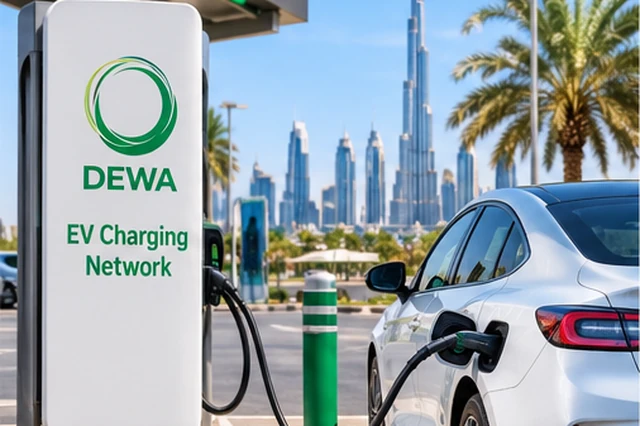
Dubai’s public electric vehicle charging network has grown to about 2,826 charging points, according to the Dubai Electricity and Water Authority (DEWA), with more sites planned for 2027. The figure was shared by Majid Hilal Al Hazami, DEWA’s vice president of smart grid projects, at the Dubai International Electric Vehicle Exhibition and Conference 2026, Emirates 24|7 and Utilities Middle East reported.
That is a sharp rise in a short time. DEWA said in January that the EV Green Charger network had passed 1,860 points, and by the end of the first quarter the count had reached 2,223.
How fast the network has grown in 2026
- January 2026: more than 1,860 charging points; 23,600 registered Green Charger users (DEWA)
- End of Q1 2026: 2,223 charging points (DEWA, via WAM)
- November 2026: about 2,826 charging points (DEWA executive, via Emirates 24|7)
- EVs in Dubai: 47,944 at the end of 2025, up from 37,486 a year earlier (DEWA data cited by Utilities Middle East)
The network includes DEWA’s own Green Charger stations and points run by independent charge point operators that DEWA licenses. Drivers can find locations through DEWA’s app.
What is planned next
The two reports describe the next phase slightly differently. Emirates 24|7, which first reported the remarks on November 12, said DEWA plans 100 to 200 new chargers in early 2027. Utilities Middle East, citing that report, described the plan as more than 100 new chargers by the end of 2027. Both point to at least 100 additional chargers next year, taking the network beyond 2,800 points.
DEWA is also receiving requests to install chargers in public places, subject to site availability and licensing, Al Hazami said.
How DEWA chooses sites and charger types
According to Al Hazami, DEWA weighs four main factors when picking locations: demand for charging, the density of electric vehicles in an area, the spread of existing stations and the need for extra points. It also checks that the electricity network can support a site and that drivers can reach it easily.
DEWA offers a 120 kW DC charger and a 360 kW charger. The 120 kW unit can take a battery to 80% in about 30 minutes, while the 360 kW unit does so in about 15 minutes, depending on the vehicle.
What it means for residents and businesses
For residents weighing an electric car, the number and spread of public chargers is one of the practical questions. For businesses such as fleet operators, malls and property developers, the licensing framework DEWA launched in October 2024 allows independent operators to build and run charging infrastructure, which has widened the network beyond DEWA’s own stations.
The exhibition, organised by Dubai’s Roads and Transport Authority and China EV100, features 120 companies showing electric vehicles, charging equipment and autonomous driving technology. The UAE’s wider clean-power build-out is covered in our report on the IEA’s solar outlook for the UAE.
Sources: Emirates 24|7, Utilities Middle East, DEWA, WAM